Support Groups
Feeling like no one truly understands what you’re going through can be one of the heaviest burdens to carry. You’re managing symptoms, navigating daily life, and trying to make progress—often in silence.
Support groups offer something uniquely powerful: a confidential, structured space where people facing similar challenges come together to share, learn, and heal alongside one another.
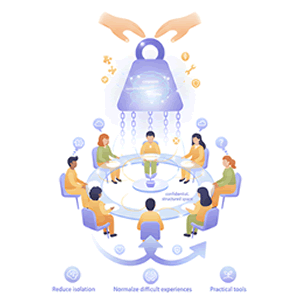
As a proven adjunct to individual therapy, support groups reduce isolation, normalize difficult experiences, and equip participants with practical tools that make a real difference between sessions.
Why Support Groups Matter
Support groups play a vital role in fostering emotional resilience and connection. By providing a safe and understanding environment, they encourage individuals to share experiences, gain insights, and feel empowered on their mental health journey.
-
Emotional Support and Validation
There’s profound relief in being heard by someone who genuinely understands—not just intellectually, but through lived experience.
Support groups create a judgment-free environment where participants connect with peers who share similar struggles, offering empathy that feels both authentic and deeply comforting. That sense of being truly seen can shift the entire emotional weight of a challenge.
-
Reduced Isolation and Sense of Belonging
Mental health challenges can quietly erode your sense of connection to others. Support groups rebuild that connection. Participants move from feeling alone in their experience to becoming part of a community of people navigating similar journeys.
Many find that these relationships extend beyond the group setting, forming friendships rooted in mutual understanding and trust.
-
Practical Coping Strategies from Peers
Hearing how someone else has managed a panic attack, processed grief, or navigated a difficult life transition carries a particular kind of weight.
Support groups surface real-world techniques—tested in everyday life, not just in theory—that participants can immediately apply to their own challenges. This peer-to-peer exchange of strategies adds a practical dimension to the healing process.
-
Accountability and Progress Reinforcement
Recovery and growth are easier to sustain when others are invested in your progress. The consistent encouragement and gentle accountability that comes from a support community helps participants stay committed to their mental health goals.
Knowing that others are showing up—and that your presence matters to them—creates meaningful motivation to keep moving forward.

How Support Groups Work
Support groups provide a safe and compassionate space for individuals to share their experiences and receive encouragement from others facing similar challenges. They play a vital role in fostering emotional healing, building connections, and empowering participants on their mental health journeys.
-
Professional Facilitation Combined with Peer Connection
Support groups offered through counseling are professionally facilitated, meaning they balance the spontaneity of peer connection with clinical structure and guidance.
This combination ensures conversations remain constructive, safe, and aligned with each participant’s broader treatment goals. It’s peer support, without the risk of it becoming unstructured or counterproductive.
-
Goal-Oriented Focus Aligned with Individual Therapy
Rather than operating in isolation, support groups function as a natural extension of individual counseling.
Group discussions reinforce the coping skills, insights, and goals established in one-on-one sessions, giving participants a regular opportunity to practice what they’re learning and receive feedback in a real-world social context.
-
Safe, Confidential Environment for Shared Experience
Every participant enters the group with the same expectation: that what is shared stays within the group.
This confidentiality creates a foundation of trust that allows people to speak honestly about their experiences—often sharing things they haven’t felt safe saying elsewhere. That openness, in turn, accelerates healing.
-
Diverse Topics and Focus Areas Available
Support groups are available across a wide range of focus areas, including depression, anxiety, grief, caregiver stress, addiction recovery, and major life transitions.
This variety ensures that participants can find a group that genuinely matches their current experience and clinical needs, rather than settling for a one-size-fits-all approach.
Integration with Individual Counseling
Support groups work best when they complement—not replace—individual therapy. While one-on-one sessions provide the space for diagnosis, trauma processing, and personalized treatment, the group setting reinforces those goals through community practice.
A client working through anxiety in weekly therapy, for example, might use a support group to practice coping skills, stay motivated, and gain perspective from peers who are further along in their recovery.
What Participants Experience
Over time, participants in support groups frequently report concrete, meaningful changes: improved communication skills, a stronger sense of hope, and a growing belief in their own capacity to heal.
Witnessing others make progress—especially through challenges similar to their own—builds confidence and provides a living example that recovery is possible.
Your Path Forward
Support groups are an invitation to stop navigating your challenges alone. As part of a comprehensive mental health approach, they offer community, practical growth, and the kind of encouragement that sustains long-term change.
If you’re ready to explore whether a support group is the right fit for your journey, speak with your counselor about the options available to you.
| Section | Description |
|---|---|
| Why Support Groups Matter | Support groups provide emotional resilience and connection by encouraging individuals to share, gain insights, and feel empowered in their mental health journeys. |
| Emotional Support and Validation | Participants experience relief and comfort in a judgment-free environment where they are genuinely heard and understood by peers with similar lived experiences. |
| Reduced Isolation and Belonging | Support groups combat feelings of disconnection by fostering a sense of community, where relationships and friendships based on mutual understanding can flourish. |
| Practical Coping Strategies | Support groups offer real-world techniques and peer-shared strategies that participants can immediately apply to manage their mental health challenges effectively. |
| Accountability and Progress | Consistent encouragement and accountability from peers help participants stay committed to their recovery and mental health goals, creating motivation through mutual support. |
| How Support Groups Work | Support groups create a compassionate space for sharing experiences, professional facilitation ensures safe and productive discussions, and they complement individual therapy with a goal-oriented focus. |
| Safe, Confidential Environment | Confidentiality builds trust within the group, encouraging participants to open up honestly and accelerates the healing process. |
| Diverse Topics Available | Support groups address a wide range of issues such as depression, anxiety, grief, addiction recovery, and life transitions, ensuring participants find a group that suits their needs. |
| Integration with Individual Counseling | Support groups complement individual therapy by providing a community element where participants practice coping skills and remain motivated alongside peers. |
| Participant Outcomes | Over time, participants report improved communication skills, increased hope, and confidence in their ability to heal, inspired by observing others’ progress. |
| Your Path Forward | Support groups offer community, practical growth, and sustained encouragement. Individuals should speak with their counselors to explore suitable options. |


view some of recent postings